Tax Litigation in India: Complete Procedural Hierarchy from Scrutiny to Supreme Court
Tax disputes in India rarely conclude at the desk of the initial Assessing Officer. When arbitrary additions, statutory disallowances, or unjustified penalties are confirmed in an assessment order, the Indian legal framework provides a structured, multi-tiered appellate and judicial hierarchy to protect taxpayers.
Whether litigating direct tax demands under the Income-tax Act, 1961 or indirect tax assessments under the Central Goods and Services Tax (CGST) Act, 2017, navigating this hierarchy requires precision, statutory timeliness, and procedural mastery.
This guide details the complete roadmap of Indian tax litigation across every judicial tier.
1. The Multi-Tiered Tax Dispute Hierarchy
Indian tax litigation follows a defined progression from administrative fact-finding to constitutional judicial interpretation:
Tier 1: Original Assessment & Scrutiny (AO / Proper Officer)
                           ↓
Tier 2: First Appellate Authority (CIT(A) / Joint Commissioner (Appeals) / GST First Appellate Authority)
                           ↓
Tier 3: Appellate Tribunal (ITAT / GSTAT — Final Fact-Finding Authority)
                           ↓
Tier 4: State High Court (Section 260A / Section 117 — Substantial Question of Law)
                           ↓
Tier 5: Supreme Court of India (Article 136 SLP / Statutory Appeal)
2. Tier-by-Tier Litigation Roadmap
Tier 1: Original Assessment & Scrutiny
- Direct Tax: Initiated via Section 143(2) faceless scrutiny notice, leading to an assessment order passed under Section 143(3) or Section 144 (Best Judgment).
- Indirect Tax: Initiated via Section 61 scrutiny of returns or Section 65 audit, resulting in demand orders under Section 73 or Section 74 passed via Form GST DRC-07.
- Key Litigation Rule: All factual evidence, contracts, ledger extracts, and bank reconciliations must be placed on the assessment record at this stage. Introducing additional evidence later requires formal procedural applications under appellate rules.
Tier 2: The First Appellate Authority
If the assessment order confirms additions or demands, the taxpayer must exercise the first statutory appellate remedy:
- Direct Tax — CIT(Appeals) / JCIT(Appeals):
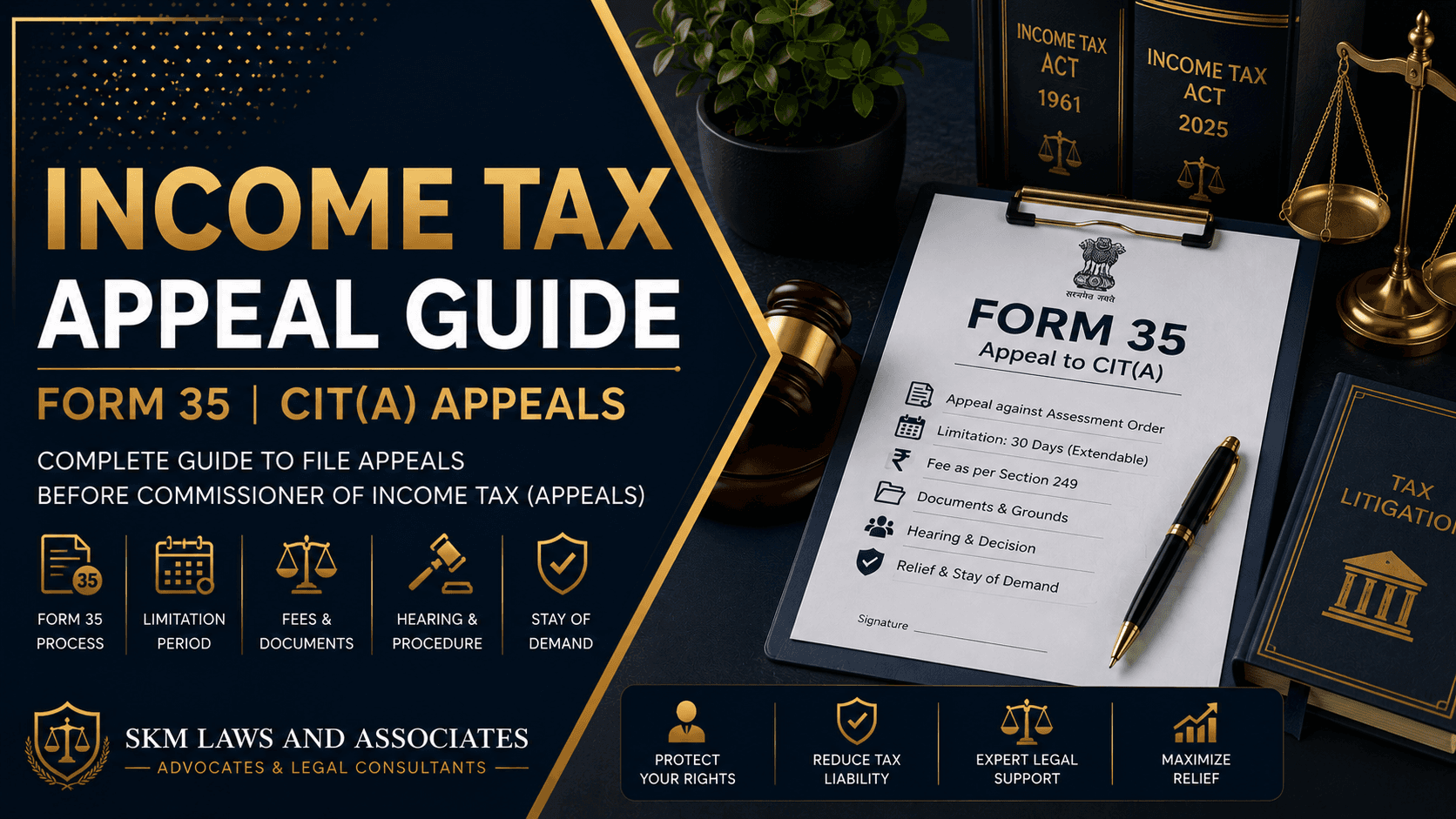
- Filed electronically in Form 35 within 30 days from the date of service of the assessment order.
- Requires concise, non-argumentative Grounds of Appeal and a Statement of Facts.
- Power of Enhancement: Under Section 251(1)(a), the CIT(A) possesses plenary powers to confirm, reduce, or even enhance the assessment.
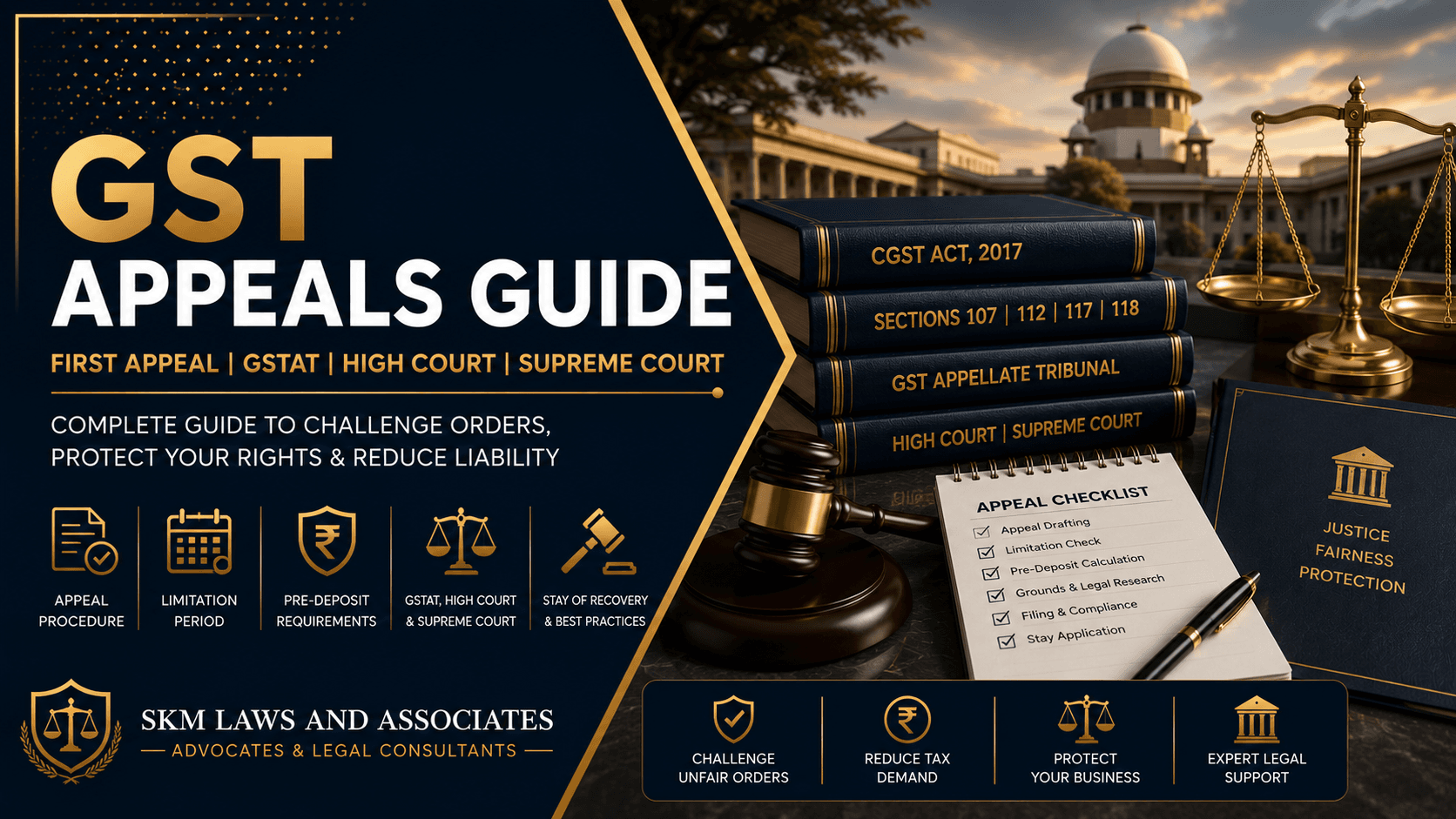
- Indirect Tax — First Appellate Authority (Section 107):
- Filed electronically in Form GST APL-01 within 3 months from the date of the DRC-07 order.
- Mandatory Pre-Deposit: 10% of the disputed tax amount must be paid prior to filing. Upon payment, recovery of the remaining 90% is automatically stayed.
Tier 3: The Appellate Tribunal (ITAT / GSTAT)
The Appellate Tribunal is a quasi-judicial body and the final fact-finding authority under Indian tax law. Findings of pure fact reached by the Tribunal cannot normally be re-agitated before High Courts:
- Income Tax Appellate Tribunal (ITAT):
- Established under Section 252; appeals filed in Form 36 within 60 days from the receipt of the CIT(A) order.
- Benches consist of one Judicial Member and one Accountant Member.
- Additional Evidence: Permitted under Rule 29 of the ITAT Rules, 1963 only upon satisfying strict criteria of reasonable cause.
- Goods and Services Tax Appellate Tribunal (GSTAT):
- Established under Section 109 of the CGST Act.
- Hears second appeals against orders passed by the First Appellate Authority or Revisional Authority.
- Requires an additional 20% pre-deposit of the disputed tax liability.
Tier 4: The High Court (Section 260A Income-tax Act / Section 117 CGST Act)
An appeal lies to the High Court from every order passed in appeal by the Appellate Tribunal, subject to a vital constitutional test:
- Substantial Question of Law: The High Court will not entertain an appeal on findings of fact. An appeal lies only if the High Court is satisfied that the case involves a substantial question of law.
- Limitation: Must be filed within 120 days from the date of receipt of the Tribunal order.
- Writ Jurisdiction (Article 226): In cases where the tax authorities act in flagrant violation of natural justice, without jurisdiction, or under unconstitutional provisions, taxpayers can directly invoke the writ jurisdiction of the High Court without exhausting departmental appellate remedies.
Tier 5: The Supreme Court of India
The apex court of the Republic of India stands at the summit of the judicial hierarchy:
- Special Leave Petition (SLP) (Article 136): An aggrieved party may seek discretionary leave to appeal against any judgment, decree, or order of a High Court or Tribunal.
- Certificate of Fitness (Article 134A): Granted by the High Court certifying that the case involves a question of general public importance requiring determination by the Supreme Court.
- Binding Precedent: Under Article 141 of the Constitution of India, the law declared by the Supreme Court is binding on all courts, tribunals, and tax authorities across India.
3. Statutory Limitation & Condonation of Delay
Strict adherence to statutory filing periods is mandatory at every tier:
- If an appeal is filed after the expiry of the statutory deadline, it must be accompanied by an application for Condonation of Delay under Section 5 of the Limitation Act, 1963 (or applicable statutory provision).
- The applicant must demonstrate "sufficient cause"—proving that the delay was neither deliberate nor attributable to negligence.
4. Stay of Demand During Pending Litigation
Filing an appeal does not automatically operate as a stay of recovery proceedings:
- Direct Tax: The taxpayer must file a stay application before the Assessing Officer and Principal Commissioner, requesting a stay upon payment of 20% of the disputed demand (pursuant to CBDT Office Memorandums). If rejected, an independent Stay Petition can be moved before the ITAT.
- Indirect Tax: Statutory pre-deposit (10% at First Appeal; additional 20% at GSTAT) grants an automatic statutory stay against recovery of the balance demand.
5. Strategic Legal Representation
Tax litigation is adversarial and evidentiary. Drafting precise Grounds of Appeal, preserving procedural objections from Tier 1, and distinguishing questions of law from questions of fact dictate the outcome of high-stakes direct and indirect tax disputes.
SKM Laws & Associates represents corporate entities, high-net-worth individuals, and business owners before Assessing Officers, CIT(Appeals), ITAT benches, and the High Courts.