Income Tax Returns • GST Compliance • Tax Planning • Appeals & Litigation • Business Advisory • Schedule Your Consultation Today
LANGUAGE:
GST Input Tax Credit and GSTR-2B Reconciliation
GSTCompliance Guide

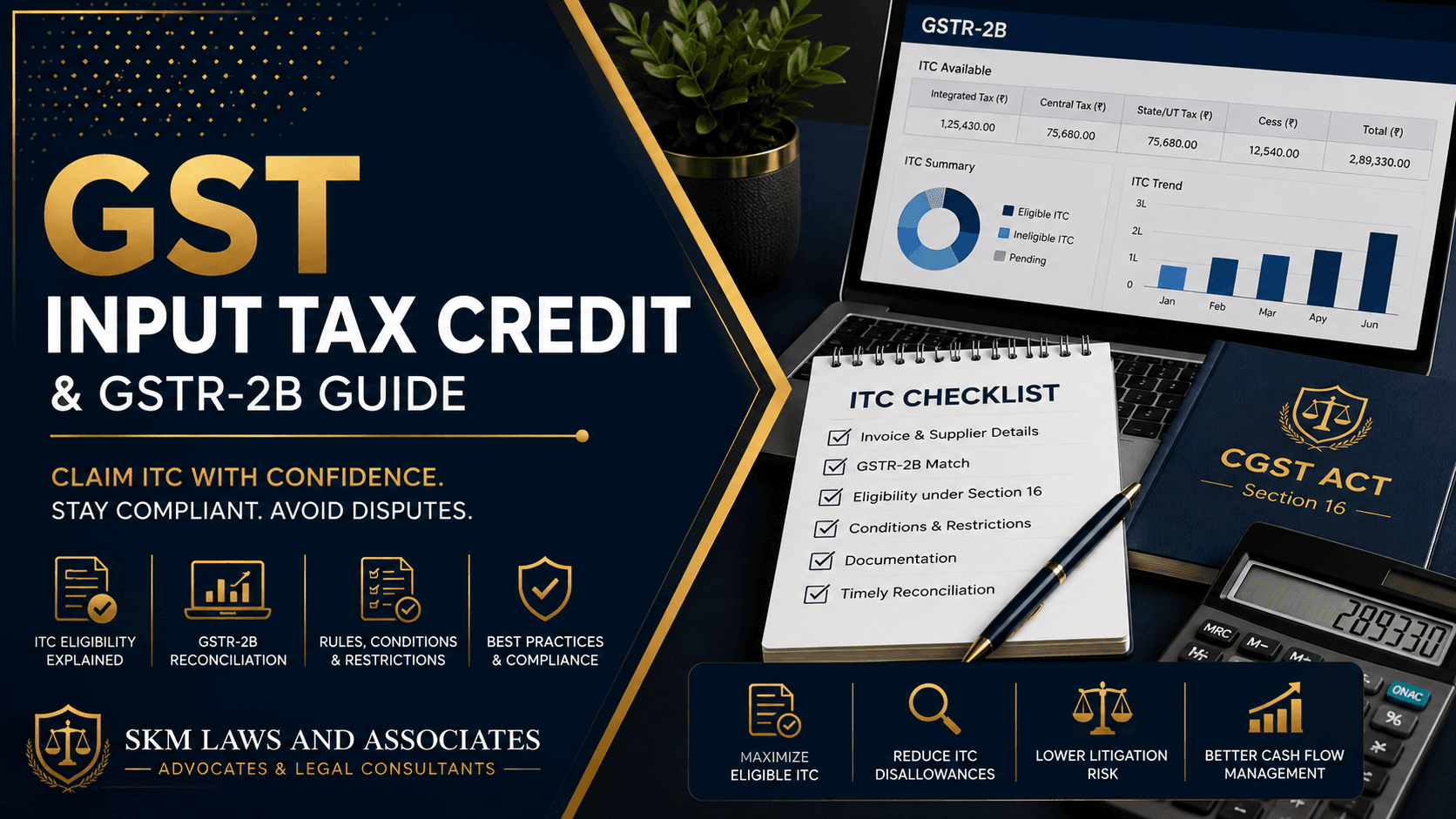
GST Input Tax Credit (ITC): Eligibility, GSTR-2B Reconciliation & Blocked Credit

Essential compliance rules under Section 16, Section 17(5) blocked credits, and monthly reconciliation.

A comprehensive guide on GST Input Tax Credit (ITC) eligibility under Section 16, GSTR-2B reconciliation best practices, and blocked credits under Section 17(5).

Adv. Sachin Kumar Mishra(Advocate & Tax Consultant)
7 min read
13/08/2026

Quick Answer

Verified Summary

Input Tax Credit (ITC) allows businesses to offset tax paid on inward purchases against outward tax liabilities. To claim ITC legally under Section 16, the buyer must possess a valid tax invoice, goods/services must be received, tax must be paid to the government, return must be filed, and invoice must reflect in auto-generated GSTR-2B.

Principle: Never claim ITC in GSTR-3B that does not appear in your auto-populated GSTR-2B statement.

1. Core Conditions for ITC Eligibility (Section 16)

Mandatory statutory criteria for claiming input tax credit

01

Valid Tax Invoice

Buyer must hold a valid tax invoice or debit note with statutory details.

02

Receipt of Goods/Services

Actual receipt of underlying goods or services is mandatory before claiming credit.

03

GSTR-2B Reflection

Supplier must file GSTR-1 and invoice details must reflect in buyer's GSTR-2B.

04

Payment within 180 Days

Value of supply plus tax must be paid to supplier within 180 days of invoice.

Frequently Asked Questions (FAQs)

Clear answers to common client questions

GSTR-2A is dynamic and continuously changes as suppliers upload invoices. GSTR-2B is a static, monthly auto-drafted statement generated on the 14th of each month that serves as the official legal basis for claiming ITC in Form GSTR-3B.

Facing GST ITC Disallowance or Notice?

Consult Adv. Sachin Kumar Mishra for GSTR-2B reconciliation audits, DRC-01 notices, and GST appellate representation.

Disclaimer: This guide is for educational purposes under current CGST Act provisions. Consult SKM Laws & Associates for tailored tax advice.

Knowledge Centre
When and Why GST Registration Is Necessary in India
GST
7 min read

GST Registration Kab Aur Kyu Jaruri Hota Hai? (When and Why GST Registration Is Mandatory)

A comprehensive, practical guide on GST registration in India. Learn when registration becomes mandatory under turnover thresholds and compulsory Section 24 provisions, business benefits, required documents, and post-registration compliances.

Read Article
Featured
Tax Litigation Hierarchy in India: Scrutiny to Supreme Court
Litigation
6 min read

Tax Litigation in India: Complete Procedural Hierarchy from Scrutiny to Supreme Court

An authoritative litigation roadmap detailing the multi-tiered tax dispute resolution framework in India, navigating Assessing Officer scrutiny, CIT(A) and GSTAT appellate hearings, High Court substantial questions of law under Section 260A, and Supreme Court Special Leave Petitions (SLP).

Read Article
Featured
Annual ROC Compliance Calendar for Private Limited Company
Company / MCA
6 min read

Annual ROC Compliance for Private Limited Company: Complete Statutory Calendar, Form AOC-4, MGT-7A & DIR-3 KYC

A comprehensive legal and statutory compliance roadmap for Private Limited Companies in India under the Companies Act, 2013, covering AGM timelines, financial statement filing in Form AOC-4, annual returns in Form MGT-7A, and Director KYC obligations.

Read Article
Featured