Income Tax Returns • GST Compliance • Tax Planning • Appeals & Litigation • Business Advisory • Schedule Your Consultation Today
LANGUAGE:
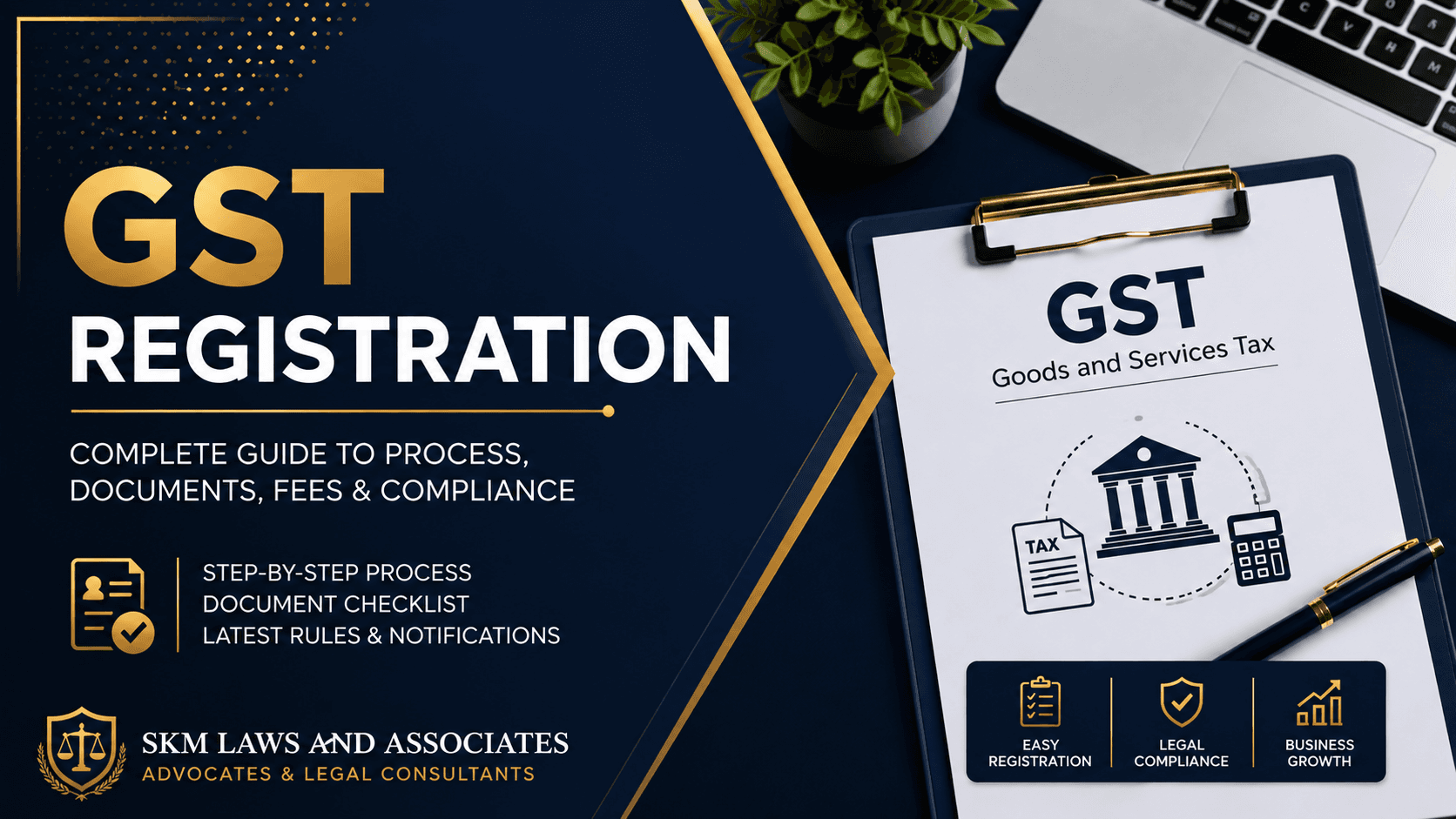
When and Why GST Registration Is Necessary in India
GSTPractical Guide

GST Registration in India: When and Why Is It Mandatory?

Understand GST Registration Requirements, Benefits, and Key Compliances in Simple Language

A comprehensive, practical guide on GST registration in India. Learn when registration becomes mandatory under turnover thresholds and compulsory provisions, the tangible business benefits, required documents, and ongoing compliance obligations.

Adv. Sachin Kumar Mishra(Advocate & Tax Consultant)
8 min read
20/08/2026

Quick Answer

Verified Summary

GST Registration requirement does not depend solely on aggregate annual turnover. Factors such as the nature of supply (goods vs. services), inter-State transactions, e-commerce marketplace selling, and specific statutory provisions under Section 24 of the CGST Act also trigger mandatory registration regardless of turnover.

Key Principle: GST registration gives your business legal identity, enables valid tax invoicing, and unlocks Input Tax Credit (ITC) for your B2B clients.

1. What is GST? (GST क्या है?)

Goods and Services Tax (GST) is India's comprehensive, destination-based indirect tax levied on the manufacture, sale, and consumption of goods as well as services across the country.

Enacted in 2017, GST replaced a fragmented web of state and central taxes (such as VAT, Service Tax, Central Excise, and Entry Tax) to establish a unified national market. Under GST, tax is collected at every stage of value addition, and suppliers can claim Input Tax Credit (ITC) on taxes paid during procurement.

2. What is GST Registration & GSTIN?

GST Registration is the formal administrative and legal process through which a business or professional is officially enrolled under the GST regime by tax authorities.

Upon successful registration, the tax department assigns a unique 15-digit alphanumeric identifier known as the Goods and Services Tax Identification Number (GSTIN). The GSTIN is linked to the business entity's PAN and contains state-specific coding.

Holding a valid GSTIN legally authorizes a business to collect GST on taxable supplies from customers, issue statutory Tax Invoices, and pass on Input Tax Credit to buyers.

3. When is GST Registration Required?

The legal obligation to obtain GST registration is determined by statutory criteria including turnover thresholds, nature of trade, and specific statutory mandates:

A

1. Threshold-Based Registration (Section 22)

Applicable when aggregate annual turnover in a financial year exceeds statutory limits (generally ₹40 lakh for exclusive goods suppliers, ₹20 lakh for service providers and mixed suppliers, and ₹10/₹20 lakh in specified special category states).

B

2. Inter-State Supply (Section 24)

Making taxable supplies of goods from one state to another generally requires compulsory registration irrespective of aggregate turnover, subject to specific notified exemptions (such as for certain handicraft goods or service providers).

C

3. E-Commerce Sellers & Operators

Persons supplying goods through e-commerce operators (such as Amazon, Flipkart, Meesho) are generally required to register, subject to recent threshold relaxations for intra-state suppliers complying with specific portal notification requirements.

D

4. Reverse Charge Mechanism (RCM) & Specified Cases

Entities liable to pay tax under Reverse Charge Mechanism (RCM), casual taxable persons, non-resident taxable persons, input service distributors (ISD), and agents supplying on behalf of principals.

E

5. Voluntary Registration (स्वैच्छिक रजिस्ट्रेशन)

Any business below the threshold limit can voluntarily register under Section 25(3) to engage in B2B supply, build client trust, and claim input credit on business purchases.

Statutory Note: GST registration applicability depends on the exact nature of business operations, supply classification, location of business premises, and current statutory notifications.

4. Tangible Benefits of Obtaining GST Registration

Obtaining GST registration is a major milestone in transitioning from an unorganized entity into an established, credible business player:

01

Legal Business Recognition

GST registration establishes you as a recognized, legally registered enterprise in the eyes of state and central authorities, banks, and corporate partners.

02

Authority to Issue Tax Invoices

Registered businesses are legally authorized to issue GST invoices and collect tax, allowing buyers to book legal business expenses.

03

Eligible Input Tax Credit (ITC)

Seamlessly offset the GST paid on your raw materials, capital goods, machinery, and commercial services against your output tax liability pursuant to Section 16.

04

Enhanced Business Credibility & Trust

Having a verified GSTIN builds immediate trust with corporate clients, wholesale suppliers, and institutional buyers who avoid dealing with unregistered vendors.

05

Seamless B2B Commercial Transactions

Most medium and large corporations mandate that vendor partners hold an active GSTIN to ensure uninterrupted supply chain credit pass-through.

06

Expansion Across State Borders

With a valid GSTIN, you can freely supply goods and services across state borders, open branches, and participate in nationwide tenders.

07

E-Commerce & Digital Marketplace Onboarding

Registration unlocks direct seller onboarding onto major online marketplaces such as Amazon, Flipkart, Myntra, and government e-Marketplaces (GeM).

08

Streamlined Tax & Banking Documentation

GST returns (GSTR-1 and GSTR-3B) serve as verifiable proof of turnover for banks when sanctioning business credit lines, OD limits, and working capital loans.

5. Documents Required for GST Registration

Preparing clean, legible documentation is critical to avoid verification queries (Form GST REG-03) and expedite approval:

PAN Card of the Business / Applicant

Mandatory

Individual PAN for proprietorship; Entity PAN for Partnership, LLP, or Private Limited Company.

Aadhaar Card of Promoters / Signatories

Mandatory

Required for biometric/OTP authentication during e-filing.

Passport-Sized Photographs

Mandatory

Recent color photos of proprietor, partners, or managing directors.

Proof of Principal Place of Business

Mandatory

Owned: Electricity bill / Property tax receipt. Rented: Valid Rent Agreement + Owner's latest Electricity bill + NOC / Consent Letter.

Constitution Documents (by Entity Type)

Mandatory

Partnership: Partnership Deed. Company/LLP: Certificate of Incorporation (COI), MOA, AOA, and Board Resolution.

Bank Account Proof

Mandatory

Cancelled cheque, bank statement, or passbook front page displaying entity name, account number, and IFSC code.

Letter of Authorization / Board Resolution

Authorizing the primary signatory to file GST applications and sign returns on behalf of the entity.

Digital Signature Certificate (DSC - where applicable)

Mandatory for Companies and LLPs to digitally sign the registration form.

6. Responsibilities After Obtaining GST Registration

Securing a GSTIN is not a one-time event; it initiates ongoing statutory compliance requirements under the law:

A

Periodic Return Filing (GSTR-1 & GSTR-3B)

Mandatory monthly or quarterly filing of outward sales summaries (GSTR-1) and monthly tax computation/payment returns (GSTR-3B).

B

Timely Deposit of Output Tax

Net tax liability after eligible ITC offset must be deposited by the statutory monthly due date (typically the 20th of the following month).

C

Maintenance of Books of Accounts (Section 35)

Maintaining true and correct records of production, inward and outward supplies, stock of goods, and taxes paid for at least 72 months.

D

GSTR-2B ITC Reconciliation

Ensuring that ITC is claimed only on invoices that appear in auto-generated Form GSTR-2B to avoid departmental demand notices.

E

E-Way Bill & E-Invoicing Compliance

Generating E-Way bills for goods movement exceeding ₹50,000 and generating electronic invoices if aggregate turnover exceeds specified thresholds.

F

Mandatory Nil Return Filing

Even if there are zero sales or purchases in a given month, a Nil return must be submitted to prevent late fees and automated GSTIN suspension.

7. Common Myths vs. Facts About GST Registration

Let us clarify the most common misconceptions about GST registration:

Common Myth

Myth: 'Once I get a GSTIN, I do not need to do anything until I cross the turnover limit.'

Legal Fact

Fact: GST registration triggers mandatory return filing obligations immediately.

Why it matters: Even if your monthly turnover is zero, you must file a Nil return. Non-filing results in accumulating daily late fees and risk of GSTIN cancellation.
Common Myth

Myth: 'The turnover threshold for GST registration is exactly the same for every business in India.'

Legal Fact

Fact: Thresholds differ significantly based on supply type and state.

Why it matters: Exclusive goods suppliers generally enjoy a ₹40 lakh limit, while service providers operate under a ₹20 lakh limit, and special category states have separate lower thresholds.
Common Myth

Myth: 'Getting a GST registration means I can claim Input Tax Credit on every personal expense.'

Legal Fact

Fact: ITC is strictly restricted to eligible business purchases under Section 16 & Section 17(5).

Why it matters: Personal expenses, food and beverages, club memberships, and specified blocked credits under Section 17(5) cannot be claimed as ITC.
Common Myth

Myth: 'Having a GST registration means I must always pay heavy taxes out of my own pocket.'

Legal Fact

Fact: GST is an indirect tax collected from the end customer and offset by purchase credits.

Why it matters: You collect GST from buyers on sales and deduct the GST you paid on business purchases (ITC), depositing only the net difference to the government.

Frequently Asked Questions (FAQs)

Clear answers to common client questions

A business is statutorily required to apply within 30 days from the date on which its aggregate turnover exceeds the prescribed threshold, or prior to commencing inter-state supplies, e-commerce operations, or other compulsory registration activities.

Professional GST Advisory

Does Your Business Need GST Registration or Clarity on Thresholds?

Assess your business model, understand inter-state and e-commerce rules, prepare error-free documentation, and secure your GSTIN smoothly with professional guidance from SKM Laws & Associates.

Disclaimer: This article is intended solely for general informational and educational purposes. Statutory turnover thresholds, compulsory registration criteria, and GST rules are subject to statutory amendments, notifications, and circulars issued by the GST Council and CBIC. Businesses must determine their legal obligations based on their specific transaction model and applicable law. For tailored legal and tax advice, please consult SKM Laws & Associates.

Knowledge Centre
Why Filing Income Tax Return (ITR) is Important in India
Income Tax
9 min read

ITR File Karna Kyu Jaruri Hota Hai? (Why Filing an Income Tax Return Is Important)

An easy-to-understand client guide on why filing an Income Tax Return (ITR) creates an official record of your income, facilitates loan and visa applications, enables TDS refunds, and builds a strong financial profile even when tax payable is zero.

Read Article
Featured
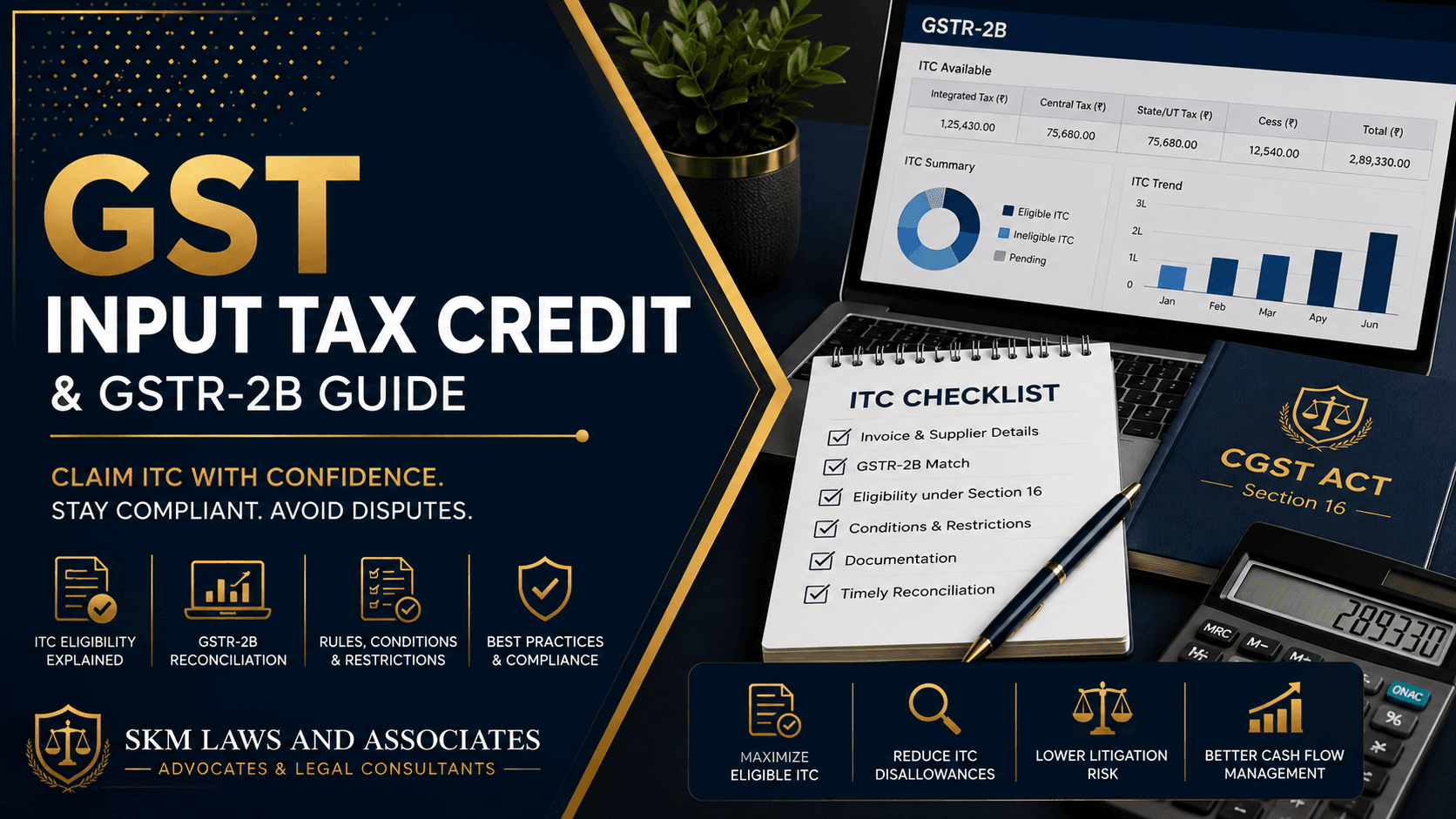
GST Input Tax Credit and GSTR-2B Reconciliation
GST
10 min read

GST Input Tax Credit (ITC): Eligibility, GSTR-2B Reconciliation & Common Blocked Credits

A comprehensive guide on GST Input Tax Credit (ITC) eligibility under Section 16, GSTR-2B reconciliation best practices, and blocked credits under Section 17(5).

Read Article
Tax Litigation Hierarchy in India: Scrutiny to Supreme Court
Litigation
6 min read

Tax Litigation in India: Complete Procedural Hierarchy from Scrutiny to Supreme Court

An authoritative litigation roadmap detailing the multi-tiered tax dispute resolution framework in India, navigating Assessing Officer scrutiny, CIT(A) and GSTAT appellate hearings, High Court substantial questions of law under Section 260A, and Supreme Court Special Leave Petitions (SLP).

Read Article
Featured